Sustainable finance generally refers to the process of taking due account of environmental, social and governance (ESG) considerations when making investment decisions in the financial sector.
More specifically, environmental considerations may refer to climate change mitigation and adaptation, as well as the environment more broadly, such as the preservation of biodiversity, pollution prevention and circular economy. Social considerations may refer to issues of inequality, inclusiveness, labor relations, investment in human capital and communities, as well as human rights issues. The governance of public and private institutions, including management structures, employee relations and executive remuneration, plays a fundamental role in ensuring the inclusion of social and environmental considerations in the decision-making process. Sustainable finance looks at environmental, social and governance (ESG) factors in both market practice and policy frameworks for banking, capital markets, investment and insurance. Sustainable finance aims at introducing environmental, social, and governance standards, as well as risk management to the lending practices of banks and FIs to promote stability of financial systems in developing countries, and channel finance to responsible entities.
Bangladesh Bank defines Sustainable Finance in a broader manner taking above definitions and Bangladesh scenario in due consideration as well as in conformity with the international norms and standards as follows:
Sustainable finance refers to any form of financial service that includes investment,
insurance, banking, accounting, trading, economical and financial advice integrating environmental,
social and governance (ESG) criteria into the business or investment decisions for lasting benefits
of both clients and society at large. Sustainable Finance is about Green Banking, Sustainable Agriculture,
Sustainable MSME, CSR that includes Socially Responsible Finance activities with respect to sustainability.
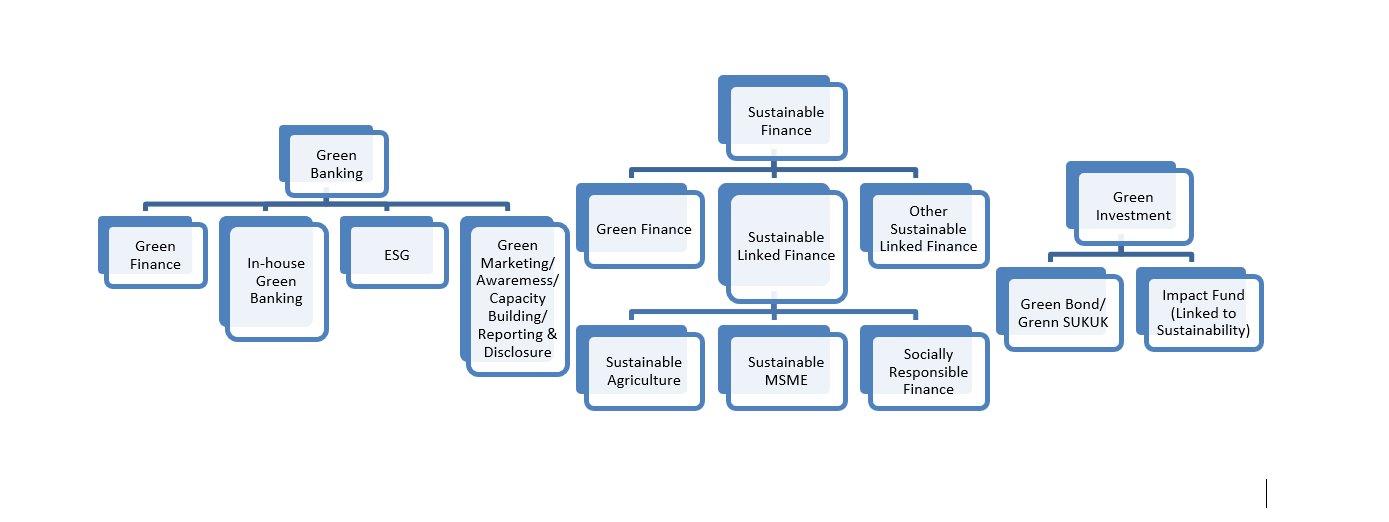
Taxonomy of Sustainable Finance by Bangladesh Bank
Goals and Objectives of Sustainable Finance
Channeling Capital: Reorienting private and public investment towards sustainable technologies, businesses, and projects.
Promoting Sustainable Growth: Fostering economic growth that reduces environmental pressures and addresses social inequities.
Managing Risks: Identifying and mitigating financial risks associated with ESG factors, such as climate-related risks (physical and transition risks).
Enhancing Transparency: Increasing the transparency and disclosure of sustainability-related information to enable informed investment decisions and combat "green washing."
Long-Term Value Creation: Encouraging a shift from short-term profit maximization to long-term value creation that considers broader societal and environmental impacts.
Supporting Global Commitments: Playing a crucial role in achieving international climate and sustainability objectives, like carbon neutrality and biodiversity protection.
As per guidelines of Bangladesh Bank Sustainable Finance Policy (SFD Circular no.03, dated: 22/10/2023), the central bank of Bangladesh has introduced
Sustainable Financing in line with Govt. sustainability strategies like
as Perspective Plan of Bangladesh, National Sustainable Development Strategy,
Intended Nationally Determined Contributions (INDCs), Bangladesh Delta Plan 2100
and Sustainable Development Goals (SDGs).
Standard Islami Bank’s Commitment to Sustainability Strategies
Sustainability has been a much talked about and widely known term over the world since 1992 when the Rio Process that began at the Earth Summit-1992
in Rio de Janeiro placed the concept of sustainable development on the international agenda formally.
Standard Islami Bank PLC. assumes sustainability as its holistic approach of works and business as the planet & people would not be safe if the way of
doing and achievement of productivity become harmful and go beyond interest of any segment of the total creation. Being a financial organization,
the SIBPLC is committed to its direct stakeholders i.e. depositors, sponsors, investment clients, regulatory bodies as well as indirect stakeholders
i.e. surroundings, natural establishments, general people, physical infrastructure, nonmaterial & spiritual issues, etc.
Meanwhile the drive of sustainability has become strengthened over the world through initiation of the Sustainable Development
Goals (SDGs) by the United Nations in 2015. SDGs are meant a global framework for achieving a better future for all, encompassing
economic, social, and environmental aspects. These goals aim to end poverty, protect the planet, and ensure prosperity for all by
2030. The SDGs are a call to action for all countries, regardless of their development status, and they are designed to be integrated,
recognizing that actions in one area can affect outcomes in others.
Keeping the shariah principles at the height, the SIBPLC has been operating all of its activities to uphold trust of people on the
Bank with efficient financial management in the productive & value generating sectors without damaging ecosystem.
Sustainability Strategy of Standard Islami Bank PLC.
The SIBPLC. has been according all out efforts to have a sustainable environment with promoting eco-friendly banking preserving natural resources. Sustainable finance generally refers to the process of taking due account of environmental, social and governance (ESG) considerations when making investment decisions in the financial sector.
The Banking sector is trying to implement at least 12 SDGs directly out total 17 SDGs as per Bangladesh Bank Policy: No poverty (SDG 1), Zero hunger (SDG 2), Gender equality (SDG 5), Clean water and sanitation (SDG 6), Affordable and clean energy (SDG 7), Decent work and economic growth (SDG 8), Industry, innovation and infrastructure (SDG 9), Reduced inequalities (SDG 10), Responsible consumption and production (SDG 12), Climate action (SDG 13), Life below water (SDG 14), and Partnerships for the goals (SDG 17).
Other 05 SDGs are: These are also interconnected
Good health and well-being (SDG 3), Quality education (SDG 4), Sustainable cities and communities (SDG 11), Life on land (SDG 15), Peace, justice, and strong institutions (SDG 16).
Other 05 SDGs are: These are also interconnected
Good health and well-being (SDG 3), Quality education (SDG 4), Sustainable cities and communities (SDG 11), Life on land (SDG 15), Peace, justice, and strong institutions (SDG 16).
Alignment of Sustainable Finance of the Bank with SDGS:
Different SDGs can be achieved through different financing sectors as demonstrated below:
Sustainable Finance – Directly:
Type
SDGs
Sustainable Finance Sectors
Sustainable Financing
Goal 6: Clean Water & Sanitation
Green Finance:
Renewable Energy
Energy & Resource Efficiency
Alternative Energy
Liquid Waste Management
Solid Waste Management
Circular Economy & Eco-Projects Financing
Environment Friendly Brick Production
Green/Environment Friendly Establishments
Green Agriculture
Green CMSME
Green SRF
Blue Economy Financing
Information and Communication Technology
Miscellaneous
Other Sustainable Linked Finance:
Low Risk Rated Projects / Initiatives using ESDD checklist.
Working capital and demand loan of Green Products/ projects/ initiatives.
Goal 7: Affordable & Clean Energy
Goal 8: Decent Work & Economic Growth
Goal 9: Industry Innovation & Infrastructure
Goal 10: Reduced Inequalities
Goal 12: Responsible Consumption & Production
Goal 13: Climate Action
Goal 14: Life below water
Goal 17: Partnerships for the Goals
We need to know about different environment friendly products to expedite sustainable economic activities build
up a sustainable policy and impressed environmental friendly habitat for all.
List of Green Products/Projects/Initiatives
A. Renewable Energy Products and Initiatives:
1. Solar Home System
2. Solar Grid
3. Solar Park
4. Solar Irrigation Pumping System
5. Solar Photovoltaic (PV) Assembly/Manufacturing Plant
6. Solar Water Heater Assembling/Manufacturing Plant
7. Net Metering Rooftop Solar System
8. Solar Pump for Drinking Water
9. Solar Cooker Assembly/Manufacturing Plant
10. Solar Air Heater & Cooling System Assembly/Manufacturing Plant
11. Solar Powered Cold Storage
12. Biogas Plants
13. Integrated Cow Rearing and Setting up of Bio-gas Plant
14. Wind Power Plant
15. Hydro Power Plant
16. Portable Solar Charging Station
B. Energy & Resource Efficiency Products and Initiatives
17. Installation of Energy Auditor Certified machineries including boiler in industries for following purposes:
i.Energy Efficiency
ii.Resource Efficiency
iii.Heat and temperature management
iv.Air ventilation and circulation efficiency
v.Business process automation
vi.Operations management
vii.Waste management
viii.Water use management
ix.Human resources development and management
x.Accounting, inventory management, marketing, sales and security management automation
G. Environment Friendly Brick Production Products and Initiatives
48. Compressed Block-Brick
49. Foam Concrete Brick
50. Environment Friendly/Brick Kiln Efficiency Improvement Project (Tunnel Kiln, HHK and other eco-friendly bricks)
H. Green/Environment Friendly Establishments Products and Initiatives
51. Establishment of Green Industry certified by appropriate authority (In Bangladesh - SREDA, Internationally - USGBC-LEED, BREEAM, CASBEE, EDGE, GRIHA)
52. Establishment of Green Building certified by appropriate authority (In Bangladesh - SREDA, Internationally - USGBC-LEED, BREEAM, CASBEE, EDGE, GRIHA)
53. Establishment Green Featured Buildings(Characteristics have been given in Annex-1)
54. Concerning Factory working environment and safety (Fire defense system, disaster defense and prevention system, workers‟ health safety system)
55. Affordable Green Housing
I. Green Agriculture Products and Initiatives
56. Earthworm compost manure production
57. Palm oil production
58. Organic manure production from slurry
59. Forestation (Social/integrated/Agro)
60. Organic Farming
61. Rooftop Agriculture/Vertical Farming or Gardening
62. Fish cultivation in cage
63. Bio-flock fish cultivation
64. Integrated Recycling System (IRS) fish cultivation/Bottom clean fish cultivation
65. Financing in coastal aquaculture
66. Floating system cultivation, Hydroponic cultivation/farming
J. Green CMSME Products and Initiatives
67. Financing in Cottage Industry
K. Green SRF Products and Initiatives
68. Community Investment for addressing Climate Resilience and Disaster Management in a concessional rate
69. Financing in Green/Clean transportation projects (cycles, hybrid car, green vehicles those run on wind, solar energy, electricity, hydrogen, bio-fuels etc.)
70. Financing in Sand-witch Panel (Floating or Movable Houses in coastal areas or climate vulnerable zone)
71. Financing in Govt. approved Eco-tourism project
72. Health and Healthcare Services
73. Digital Loan/credit using MFS or other digital medium
74. Financing in educational institutions, scholarship programs, or edtech startups that aim to improve access to quality education and workforce development.
75. Financing projects and businesses that promote gender equality, such as those supporting women entrepreneurs, addressing gender-based violence, and promoting women's rights.
76. Financing projects that promote cultural preservation, arts, and heritage conservation.
77. Natural ecosystem protection and restoration
L. Blue Economy Financing Products and Initiatives
78. Marine sustainable Fisheries
79. Mari Culture
80. Coastal Ecotourism
81. Marine Plastic Pollution
82. Coastal Renewable Energy
83. Maritime Transport
84. Green Shipyard (Ship building and ship breaking) certified by appropriate authority
(compliant with the International Maritime Organization (IMO) Guidelines for Safe and Environmentally Sound Ship Recycling under the Hong Kong Convention)
85. Eco Port
86. Marine protection
M. Information and Communication Technology Products and Initiatives
87. Hi-Tech Park
88. Broadband Networks and IT solutions
89. Internet of Things (IOT)
90. Artificial Intelligence
91. Robotics
N. Miscellaneous Products and Initiatives
92. Research and development for Sustainable Activities
93. Sustainable Supply Chain management
94. Manufacture and assembly of green building products
Sustainable Linked Finance:
Type
SDGs
Sustainable Finance Sectors
Sustainable Linked Financing
Goal 1: No Poverty
Sustainable Agriculture
Sustainable CMSME
Socially Responsible Finance
Goal 2: Zero Hunger
Goal 5: Gender Equality
Goal 6: Clean Water & Sanitation
Goal 8: Decent Work & Economic Growth
Goal 9: Industry Innovation & Infrastructure
List of Sustainable Linked Finance Products/ Projects/
A. Sustainable Agriculture Products and Initiatives
Finance to Sustainable Agriculture is linked to Sustainable Finance. Sustainable Finance aims at promoting Sustainable Agriculture through climate
change adaptation measures. Agriculture productivity needs to be enhanced especially in rain-fed areas focusing on integrated farming, oil, health
management, and synergizing resource conversation.
i. Crops
ii. Pisciculture
iii. Crop Storage
iv. Livestock
v. Poverty Alleviation
vi. Irrigation Tools
vii. Agricultural Tools
viii. Others(time-to-time as recognized by BB)
B. Sustainable MSME Products and Initiatives
Finance to Sustainable MSME (micro, small & medium as defined by SMESPD, BB) is linked to Sustainable Finance. Inclusive Sustainable Finance in MSME aims to advance financial inclusion among the most vulnerable by building resilience and enabling mitigation to climate change. This is especially the case for the transition to a low-carbon, circular and sustainable economy. Banks and FIs should have targeted initiatives to scale up finance for MSMEs.
Low Risk Rated (as per ESDD) Micro, Small and Medium enterprises financing with special focus to:
i. Herbal cosmetic manufacturing industries
ii. 100%localingredients-basedmilkprocessingindustry
iii. Handicrafts, Handloom and alike
iv. Agro feed manufacturing industry
v. Jute made products manufacturing industry
vi. Unani/Ayurvedic/Homeopathic manufacturing industries
vii. Rice processing industry
viii. Agro equipment manufacturing industry
ix. Production of bio pesticide, production of organic fertilizer
x. Bran wood projects
xi. Horticulture processing industry
C. Socially Responsible Financing Products and Initiatives
Finance to Socially Responsible Products/Projects/Initiatives/Sectors is linked to Sustainable Finance.
Socially Responsible Finance (SRF) is financing that supports actions mitigating or addressing a specific
social issue and/or seeking to achieve positive social outcomes especially but not exclusively for a target population(s).
i. Financing/Investment through MFI (MRA Regulated)/NGO (Govt. Approved) Linkage Mode for capacity building, Education, employment generation including self-employment
ii. Financing in trading of green and agro products using ICT/online/e-business platform (as recognized by BB)
iii. Financing in Orphanage/Child Rehabilitation Center/Old Age Home
D. Identification of other Sustainable linked finance Products and Initiatives
i. Low Risk Rated Projects/Initiatives using ESDD checklist (other than Green Finance, Sustainable Agriculture, Sustainable MSME, SRF and Working capital and demand loan of Green Products)
ii. Working capital and demand loan of Green Products/projects/initiatives
Sustainable Finance in Standard Islami Bank PLC.
As per instruction of Bangladesh Bank SFD Circular no.02, dated November 06, 2024, Banks must ensure that 5% of their total loans disbursed under Environment Friendly Products/Projects/Initiatives and 40% under Sustainable Financing. In continuation of this, Standard Islami Bank PLC has been encouraging Green & Sustainable Financing under the area of Renewable Energy, Energy & Resource Efficiency, Environment Friendly Brick Production, Sustainable Agriculture, Sustainable MSME, Socially Responsible Financing and Other Sustainable Linked Finance.
In continuation to the sustainability drive, Bangladesh Bank has issued SFD Circular no. 02, dated August 30, 2023. The circular discusses the importance and necessary of Environment Friendly Products/Projects/Initiatives and focus on build up of a sustainable society.